Funded by Horizon Europe under the European Health and Digital Executive Agency (HADEA), project number 101178389, the UPCYCLE project is developing novel circular value chains to transform non-recyclable plastic waste into highly recyclable and non-persistent packaging solutions.
UPCYCLE officially started on the 1st of September 2025 and brings together 19 partners from 12 countries, coordinated by Aalborg University (AAU), Denmark.
Addressing an Urgent Challenge
With more than 460 million tonnes of plastics produced annually worldwide, only 9% is effectively recycled, while plastic packaging accounts for 40% of demand and 60% of plastic waste in Europe. Most packaging is used once, with two-thirds discarded within a year, often relying on complex or contaminated plastic streams that persist in the environment for centuries.
UPCYCLE aims to tackle these challenges head-on by developing novel circular value chains that convert today’s non-recyclable plastic waste into highly recyclable and non-persistent packaging materials. By doing so, the project will reduce reliance on incineration and landfill, support EU circular economy goals, and create a credible pathway toward non-persistent, safe, and sustainable plastics.
Building on Success and Scaling Innovation
UPCYCLE builds on the promising results of the H2020 UPLIFT project and moves beyond small pilot-scale research to reach TRL7 demonstration. The project will scale a plastic biorefinery concept combining:
- A Safe-and-Sustainable-by-Design (SSbD) framework,
- AI-powered process intensification and digital twins,
- Smart polymerisation and formulation strategies using renewable additives,
- And eco-design approaches that ensure materials can be safely recycled or designed to degrade under controlled conditions if leakage occurs.
Target applications include fresh food flexible packaging, short-lifetime deli packaging, beverage bottles, and personal care packaging—all sectors where recyclability and end-of-life performance are critical.
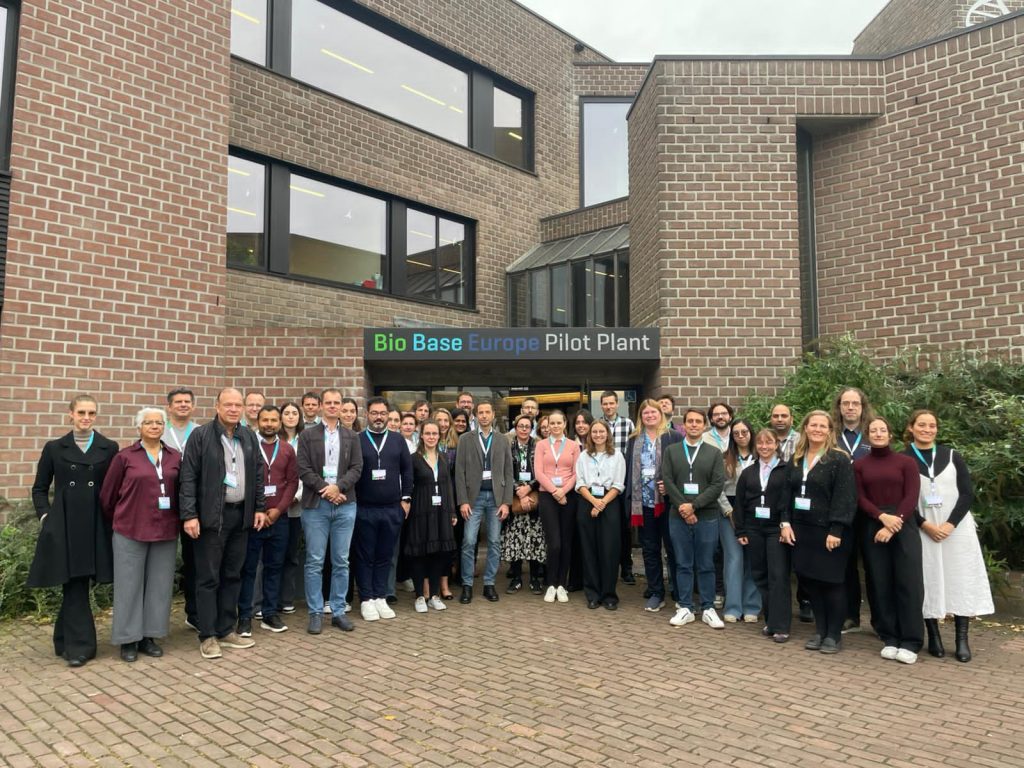
Kick-Off Meeting Highlights
The two-day meeting in Gent featured presentations from all Work Package leaders, a European Commission briefing, and the first General Assembly of the consortium.
Key sessions included:
- Advances in scalable depolymerisation and fermentation of plastic waste,
- Eco-design and formulation of recyclable and non-persistent polymers,
- SSbD, biodegradability and compostability assessments,
- Strategies for dissemination, communication, and exploitation,
- And site visits and pilot demonstrations at BBEPP facilities.
A dedicated Advisory Board session also allowed external experts to provide guidance on the project’s direction and ensure strong links with industry, regulation, and policy frameworks.
Impact and Outlook
By 2029, UPCYCLE will deliver demonstrated packaging materials at TRL7 that are:
- Highly recyclable through mechanical and chemo-enzymatic recycling,
- Non-persistent, avoiding long-term environmental pollution,
- More biodegradable where appropriate, ensuring safe degradation in controlled settings,
- And designed to meet market and regulatory requirements while reducing GHG emissions by 30% compared to current bioplastics.
Through these innovations, UPCYCLE aims to provide trustworthy, scalable, and sustainable alternatives for Europe’s packaging industry, supporting EU strategies on plastics, the Single-Use Plastics Directive, and the Circular Economy Action Plan.
A Strong and Multidisciplinary Consortium
UPCYCLE brings together 19 partners from 12 countries, combining world-leading academic expertise, industry innovators, applied research centres, and communication specialists. Together, they cover the full plastics value chain, from waste collection and depolymerisation to polymer design, formulation, demonstration, and market deployment.
The consortium is coordinated by Aalborg University (Denmark) and includes:
- EROSKI (Spain) – major cooperative retailer with expertise in packaging value chains.
- EVYAP (Türkiye) – leading personal care manufacturer, end-user of sustainable packaging.
- PACK4FOOD (Belgium) – specialist in packaging innovation and validation.
- BIO-MI (Croatia) – SME focusing on bioplastics R&D and production.
- TECNARO (Germany) – industry leader in biopolymer materials.
- Bio Base Europe Pilot Plant (Belgium) – hosting pilot-scale demonstration of UPCYCLE’s biorefinery.
- Bioplastech (Ireland) – SME developing biobased and biodegradable polymers.
- DTU (Denmark) – advancing eco-design and polymer science.
- AIMPLAS (Spain) – European leader in plastics materials innovation and assessments.
- Leibniz Institute – Hans Knoll Institute (Germany) – expertise in microbial pathways.
- Forschungszentrum Jülich (Germany) – cutting-edge applied research in bioprocessing.
- University of Natural Resources and Life Sciences – BOKU (Austria) – sustainable biopolymer development.
- Helmholtz-Zentrum Berlin (Germany) – advanced materials and energy expertise.
- Lund University (Sweden) – polymer chemistry and sustainability research.
- RWTH Aachen University (Germany) – techno-economic and life cycle assessments.
- University College Dublin (Ireland) – academic partner in polymer science and valorisation.
- AEIMIS (Spain) – expertise in sustainable marketing and business models.
- ECO Imagination (France) – leading project communication, dissemination, and exploitation.
Funded by the European Union under grant agreement number 101178389. Views and opinions expressed are however those of the author(s) only and do not necessarily reflect those of the European Union or the European Health and Digital Executive Agency (HADEA). Neither the European Union nor the granting authority can be held responsible for them.